
Home / How it works
Your next hire in four steps

We find, train and onboard your dedicated professional. Then we supervise and support them for as long as they work with you.
 Step 01
Discovery call
Define the role, the system, the volume. Leave with a plan.
 Step 02
Solution presentation
Review the role, the rate, and how it will integrate.
 Step 03
Find and vet
We screen against a property management baseline, often from an already vetted bench. You meet the finalist.
 Step 04, ongoing
Onboarding and Standing Watch
Live in five business days. Managed for as long as they are on your queue.
Discovery
call
We start with your queue, not a pitch. What is the system, what is the volume, what is actually breaking. By the end of the call you know which role fits and roughly what it costs.

Role and scope
What the role needs to cover, which PMS you run, and what done well looks like for this seat.
Volume and timeline
Ticket volume or workload, your urgency, and a realistic start date.
Initial fit and next step
A first read on which role fits, a rough monthly cost from the published rates, and what happens next.
Solution
presentation
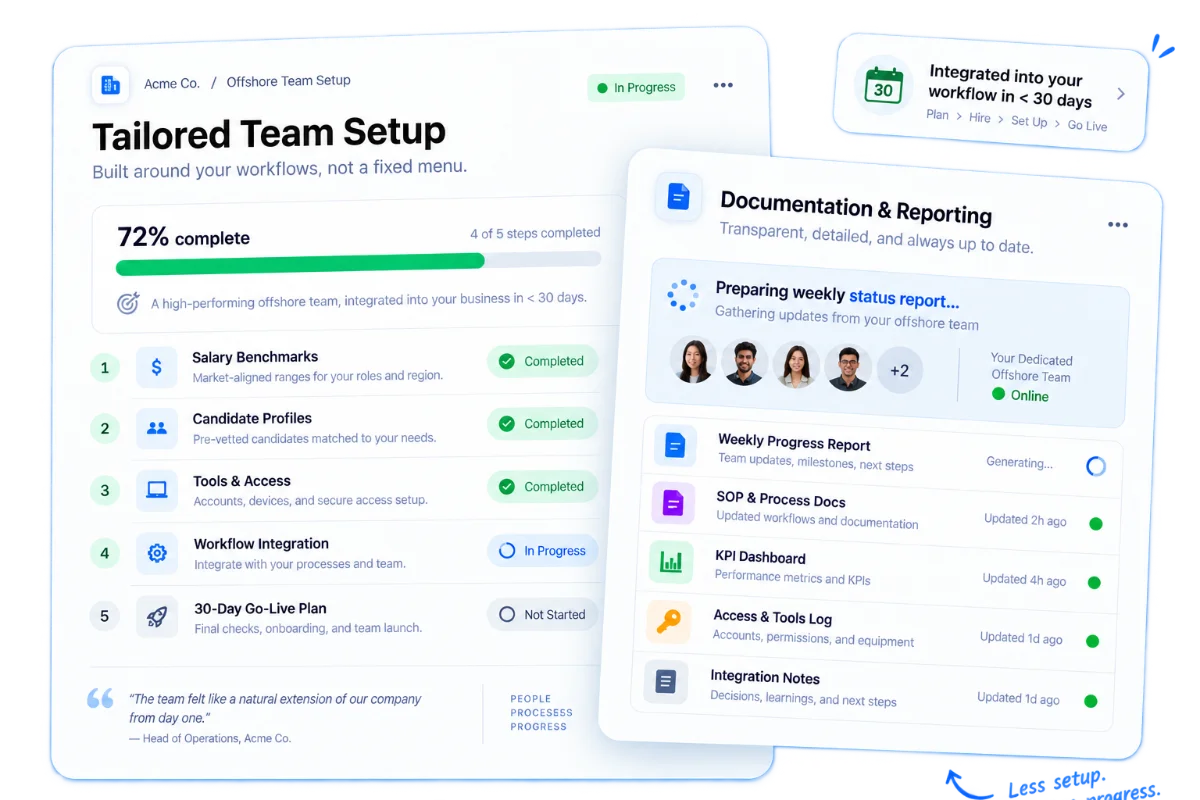
You get a specific plan back, not a menu. The role, the published rate, how the person reports to you, and what access looks like on day one.
Role and published rate
The exact role recommended, the monthly rate from our published pricing, and what is included at that tier.
How they fit into your team
Reporting line, hours, and how the role hands off to your existing staff.
Systems and access plan
Which PMS login, phone line and email get created, and at what permission level.
Find
and vet
Every candidate is screened against a property management baseline before they are matched to your role. You meet the finalist before they touch your queue. And because we keep a bench of already vetted PM professionals, a fit is often ready to start the moment you are, not weeks out.

PM-specific screening
Reading a lease clause, following an escalation ladder, writing to a resident or owner clearly. Tested before role matching starts.
Role match
Recruited and matched against the specific role from your solution presentation, not trained generically and hoped into a fit.
Ready from the bench
We keep a pipeline of pre-vetted professionals across every role on this site. When one is already available, you skip the search entirely and move straight to training.
You meet the finalist
A short intro call or written profile before training starts, so there are no surprises on day one.
The screening path
- Applied 100%
- Language and comms screen 22%
- Systems and trust accounting test 9%
- Client interview 4%
- Placed 1.5%

Onboarding and
Standing Watch
Two halves that do not blur together: getting the seat live, then keeping it managed. The first has a finish line. The second does not.
Getting started
Five business days from signed plan to first ticket. Then two paid weeks on real work before anything ongoing is signed.
- Day 1. We read your process. Vendors, thresholds, who signs off, what counts as an emergency.
- Day 2. You create the logins. Email, phone line and system access, under your brand, at the permission level you choose.
- Day 3. Training on your rules. Escalation ladder, priority levels, scripts, built from what you gave us and from how PM companies run generally, not a generic call-centre script.
- Day 4. First real tickets. Supervised, handled by one named professional, not a rotating pool.
- Day 5. We review the week. Every ticket, together. Anything handled wrong gets fixed and written into the rules.
Before day one, we need from you
- A login at a permission level you set
- Your current vendor or supplier list, with numbers
- Who approves spend, and up to what amount
- An email and phone line under your brand
- A plain answer to what counts as an emergency
If one of these is missing, we say so before a start date is set. We don't launch on a guess.
The two-week pilot
Two paid weeks on your real tickets, in your system, before anything longer is signed. You watch the actual work, not a demo.
Month to month after that. 30 days notice, either side. Wrong fit in the first 30 days, and we replace the person free.

Standing Watch
Most staffing companies onboard hard for a few months, then step back. Standing Watch has no end date. It is how every placement is managed for as long as they are on your queue, not just at the start.
Foundation
Weeks 1 to 4
Rules, access and training locked in. A daily supervisor check on ticket quality while the person ramps.
Alignment
Months 2 and 3
Most workflow refinements happen here. A performance review every two weeks against the KPIs set in discovery. Escalation patterns and edge cases get written into the rules as they come up.
Standing Watch
Month 3 onward, for the life of the engagement
Ongoing. No end date.Monthly performance review, continuing indefinitely. A named supervisor stays assigned to the account, not just the hire. Replacement, retraining or reassignment is handled on our side if something changes on yours: a volume shift, a new tool, a policy change. You are not the one managing the manager.

Standing Watch does not end at day 30, 90 or 180. There is no point where we consider the hire onboarded and step back. The same supervision that gets someone started is still running the day they have been on your queue a year.
Book a callOne published rate, nothing added later
One published monthly rate, the same one from step 02, covers the role and Standing Watch both. Recruiting, training, supervision and ongoing management are not a separate line item.
Frequently asked questions
What happens if a placement is not working out?
Free replacement inside the first 30 days. After that it goes through the Standing Watch review process before you are asked to make a call on the person.
Does Standing Watch cost extra?
No. It is included in the published rate for the role, not a separate management fee layered on top.
Who do I talk to if something is wrong, the person or Apollo?
Both. Escalate directly to the person for day to day work, or to their named supervisor for anything about performance, fit or the account generally.
How is this different from an agency that places someone and disappears?
Most staffing providers step back once someone is placed. Standing Watch means a supervisor stays assigned to your account for as long as the placement runs, not just for an onboarding window.
Can I cancel if I do not need the role anymore?
Month to month, 30 days notice, either side. The full terms are on the pricing page.
How fast can someone actually start?
It depends on whether a fit is already on the bench. When one is, we move straight to training and your five business day onboarding starts at once. When a role needs a fresh search, we give you the search timeline on the discovery call rather than a figure here.
Tell us the role. We'll walk you through the four steps on the call.
Forty-five minutes, no deck. Bring one week of your real workload.
Book a callPaid two-week pilot first. Month to month after, 30 days notice.